Progressive Slots Online in the UK: How Jackpots Work
 Available in GB
See how wager contributions, trigger rules and payout mechanics shape progressive jackpots, and where demo play differs from real-money play.
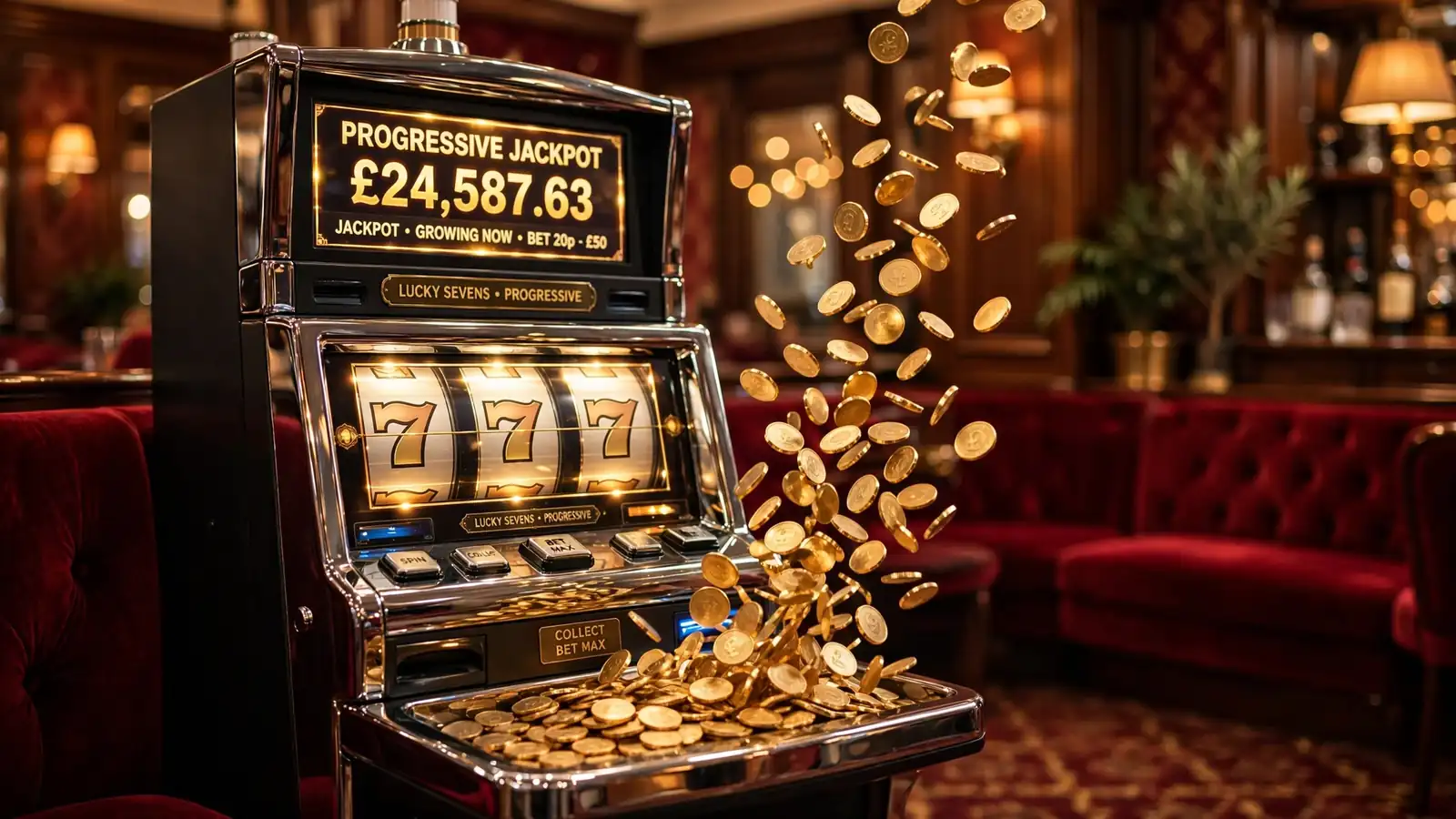
Table of Contents
- The Jackpot Is Part of the wager
- How a Shared Jackpot Grows
- One Game, Several Ways to Trigger the Prize
- What the Maths Says About the Chase
- Playing for Real Money: Returns and Payouts
- How a Progressive Slot Decides to Pay
- Free Spins, Demo Play and Their Limits
- Playing Online Without Mistaking a Demo for the Real Thing
- Mystery Jackpots and Must-Hit-By Games
- A Named Game in a Changing Catalogue
The Jackpot Is Part of the wager
A progressive jackpot slot is defined by a prize that can grow while the game is being played. Unlike a fixed jackpot, whose value is set in advance, a progressive prize changes as qualifying wagers add to its pool. The display may show a sum far larger than an individual stake; the important distinction is that the prize is not simply a fixed feature of the machine. Its value is connected to play.
That connection is part of the wager’s design. A small portion of each stake can be directed towards the jackpot, while the rest supports the ordinary game. Across progressive jackpot slots, the contribution is typically between 1% and 3% of a wager. The amount is not a separate tip or an optional purchase: it is built into the game’s allocation of money. The screen’s rising total is the visible trace of that arrangement.
The word “progressive” describes the prize, not a player’s progress towards winning it. A larger displayed amount does not mean that a particular game is closer to paying out, nor does it make a win more likely on the next spin. The pool grows according to the game’s rules; the player’s chance of triggering the jackpot is a separate matter. That distinction can disappear in the glow of a changing number. It should not.
In practical terms, progressive slots online in the UK sit inside the same commercial gambling system as other remote casino games. The UK Gambling Commission regulates gambling activity, including online casinos. For Great Britain, its authority over remote gambling offered to consumers does not depend on where an operator keeps the equipment that runs the game. A server elsewhere does not move the customer outside the regulatory frame.
The Commission is the sole regulator for commercial gambling in Great Britain. It issues operating licences to businesses and personal licences to individuals working in regulated roles. Those are different permissions: a company’s authority to offer gambling is not the same thing as an individual’s licence to perform certain functions. The distinction is characteristic of a system that regulates both the business and the people responsible for its operation.
Slots at UK Online Casinos: Providers and Games
A progressive jackpot is therefore not a legal category in its own right. It is a type of slot game offered within a regulated market. The rules governing the operator remain relevant whether the prize is modest or has grown into a conspicuous headline figure. In Britain, remote operators serving consumers must hold the appropriate Gambling Commission licence, including when their key equipment is located outside the country.
The game’s economics also explain why its ordinary play may feel different from a slot without a growing prize. Progressive slots often have a base-game return to player, or RTP, in the 88%–92% range. The RTP describes the theoretical proportion of stakes returned through play over time, not a promise about an individual session. In these games, the difference in payout is directed towards the jackpot pool. The prize is not conjured from spectacle; it is financed through the game’s structure.
That does not make every progressive game identical. The contribution and the presentation vary by game, and the jackpot’s rules determine what counts as a winning event. Those details belong to the game itself, rather than to the word “progressive”. The term says that the prize can increase; it does not, on its own, say how a winner is selected or what conditions apply.
The label also gives no assurance about quality. “Best” or “top” progressive slots are judgments, not a formal class recognised by the regulator. A prominent jackpot may attract attention, but size alone says little about the game’s other features or whether its terms suit a particular player. New progressive games may appear as providers change their catalogues, while availability depends on what an operator carries. A name on a screen is not a regulatory endorsement.
Progressive penny slots in the UK are still progressive jackpot slots if the game’s prize grows through contributions linked to wagers. The phrase “penny” describes a low-stake association in ordinary usage, not an exemption from the mechanics or rules of online gambling. The market has its own limits on stakes and game cycles, and the progressive label does not override them.
In Britain, remote operators serving consumers must hold the appropriate Gambling Commission licence, regardless of where their key equipment is located.
There is a quiet social bargain in this format. The appeal is collective in appearance: many wagers help enlarge one prize, even though each player encounters the game individually. Regulation, by contrast, insists on identifiable responsibility—licensed businesses, licensed individuals and oversight tied to the market in which gambling is offered. The jackpot gathers money into a single figure; the regulator disperses accountability across the system that sells the chance. A neat contrast.
Top online casinos in the UK
- SlotoSportBonus: 500% up to £ 10 200+ 777 FS · Payout speed: 1-3 business days
- x3betBonus: Welcome Pack 100% Up to £1.000 + 200 Free Spins · Payout speed: 1-3 business days
- DieselwinBonus: Welcome Pack 250% up to £4000 + 200 FS · Payout speed: 1-3 business days
- WinBeastBonus: €5000 + 500 FS + €650 Freebet · Payout speed: 1-3 business days
- JetsetspinsBonus: 200% Bonus + 100 Free Spins + Free Royal Wheel · Payout speed: 1-3 business days
- SpinFormulaBonus: 550% Up To £15,000 + 550 FS · Payout speed: 1-3 business days
- NightLuckBonus: Welcome Pack + 805% Up To 6400€ + 280 FS · Payout speed: 1-3 business days
- ChanzeBonus: Slots Welcome Bonus #1 200% up to €500 · Payout speed: 1-3 business days
- ZombillionBonus: Welcome Pack 250% up to £4000 + 200 FS · Payout speed: 1-3 business days
How a Shared Jackpot Grows
A progressive jackpot is not necessarily a prize sitting inside one casino’s version of a game. In a networked arrangement, wagers made on connected slot machines feed a shared pool. The machines may be available through different operators, but if those operators carry the same progressive slot game as part of the network, their connected play can contribute to one common jackpot.
That connection changes the scale of the prize’s accumulation. A single game displayed on a screen may be the visible face of a larger system: wagers arrive from separate accounts and operators, while the pool belongs to the network linking the game. The player sees symbols, reels and a jackpot figure. Behind them is a less theatrical arrangement of connected machines.
The word “shared” matters. It does not mean that every progressive slot in a casino catalogue contributes to the same pot, or that every game with a similar name belongs to one network. The shared pool is tied to connected machines carrying the same progressive game. A title can appear across operators without every version necessarily being part of one pool; the relevant connection is the game’s network, not the general resemblance of its screen or theme.
Classic Slots Online in the UK: How They Work
This also explains why the jackpot figure can be difficult to understand from the perspective of one operator alone. A casino may provide access to a game, but it need not be the only place where wagers enter its network. If the same progressive slot is carried by other operators in that network, contributions from connected play elsewhere can join the same pool. The operator’s catalogue is therefore not always a map of the prize’s full reach.
There is an old social idea hidden in this machinery: a crowd can fund a prize no single member could sensibly build alone. In the traditional lottery, the crowd is obvious; in a networked slot, it is concealed behind separate screens and private accounts. Each wager appears individual. The pool makes the collective part visible, though only as a changing total.
That collective funding should not be confused with a promise that every wager on every version of a game joins the jackpot. The defining condition is connection to the shared pool. A stand-alone version, or a different progressive title, is not automatically part of it merely because the same operator offers it. The network’s boundaries matter more than the casino’s branding.
For anyone comparing progressive jackpot slots at UK sites, the useful distinction is not simply which operator displays a game. It is whether that particular game is connected to a network pool shared across operators. A game available in several places may have a wider pool than one confined to a single connected environment, but the number of logos on a screen is not itself proof of how the pool is organised. The game’s stated jackpot arrangement is the meaningful detail.
Payment method is a separate matter. A search for Bitcoin slots, for instance, describes how someone hopes to fund an account; it does not establish that a particular game is networked, or that a wager contributes to its jackpot. The pool is built through connected play, not by the name of a payment option. Money can take different routes into an account without changing the architecture of the game.
A game’s presence in a casino catalogue does not guarantee it is part of a shared network pool; the connection is tied to the game’s network, not the operator’s branding.
The same distinction helps make sense of new releases and lists of progressive titles. A newly added game may join a network, but its appearance in a catalogue alone says nothing about which other operators share its pool. Nor does a list of games reveal whether each title has a common network jackpot or a separate arrangement. The central question is always the connection behind the individual game.
So a shared jackpot is both a prize and a piece of infrastructure. Its growth depends on wagers reaching connected machines, and its reach can cross operator boundaries when those operators carry the same progressive slot within the network. The screen makes the pool look local. Its funding may not be.
One Game, Several Ways to Trigger the Prize
The word “progressive” describes a jackpot that can grow; it does not, by itself, explain how the prize is won. Progressive jackpot slots online in the UK can use different trigger conditions. One game may award a jackpot through a random trigger, while another may require a particular combination or a route through a bonus round. The prize may look similar on screen. The rules that bring it within reach are not.
A random trigger does not depend on landing a named winning combination. Instead, the game can select a jackpot event at random. That separates the trigger from the familiar logic of matching symbols: a jackpot need not appear as the largest line win or as the final step in a visible sequence. “Random” describes the way the event is triggered, not a promise that it will happen within any particular stretch of play. There is no schedule hidden in the label.
ELK Studios and Amatic Casinos in the UK: A Guide
Condition-based jackpots make the route more legible, though not necessarily more predictable. A game may require a specific combination, or the player may need to enter a bonus round before the jackpot can be awarded. These are different conditions: one concerns what appears in the game, the other whether a particular feature is reached. Even within that broad distinction, the details belong to the individual game. “Progressive jackpot” is a category, not a complete set of instructions.
That distinction matters because the visible jackpot meter can draw attention away from the less prominent question of eligibility. A game with a random trigger may have more than one jackpot tier, and a specialist review has reported that certain such games require a minimum bet to qualify for the highest tier. This is a claim about particular games, not a rule that can be applied across progressive casino slots in the UK. The amount and conditions should not be inferred from the word “random”, nor assumed to be identical from one game to another.
The two trigger families also invite different expectations. A combination-based award appears tied to a recognisable event in the game; a bonus-entry condition makes the feature itself part of the route. A random award offers no such visible sequence. That can make the jackpot feel less like a prize earned by a dramatic final symbol and more like an event that interrupts ordinary play. The distinction is mechanical, but it shapes the story the game tells about winning.
Random Trigger
The game selects a jackpot event at random, independent of matching symbols or a visible sequence.
Condition-Based
Requires a specific symbol combination or entry into a bonus round before the prize can be awarded.
For online slots with progressive jackpots, the useful question is therefore not simply whether the jackpot is large or growing. It is what must happen for the prize to be awarded, and whether any tier has an additional qualification condition. Those details cannot be derived from the jackpot display or from the fact that two games share the same broad format. A game can be progressive without using the same trigger as another progressive game.
The labels are not interchangeable. “Random” does not mean that every spin is equally eligible under every stake condition; the reported minimum-bet qualification for some top tiers is a reminder that eligibility can be narrower than the headline suggests. Nor does a bonus round automatically mean the jackpot is guaranteed once that round begins. The trigger condition identifies a route to the award, not a certainty of reaching it.
That is the small print of spectacle. A glowing meter can make several games look like variations on one promise, while the path to the prize differs from game to game. In slots with progressive jackpots, the trigger is part of the game’s design, not a decorative detail. The jackpot is only half the story.
What the Maths Says About the Chase
The arithmetic behind a progressive jackpot slot has two related parts: the return built into the base game and the contribution that feeds the prize pool. Progressive jackpot slots typically direct between 1% and 3% of each wager to that pool. The contribution is small beside the full stake, but it accumulates across play on connected games.
Online Craps Casinos UK: What Can Be Verified
That allocation helps explain why the base-game return can be lower than in a comparable slot without a progressive prize. RTP, or return to player, describes the proportion of wagers a game is designed to return over extended play. For progressive slots, the base-game RTP often sits between 88% and 92%; the difference in payout is directed towards the jackpot pool.
These figures describe a structure, not a forecast for an individual session. A stated RTP does not say what a particular player will receive, nor does the contribution rate reveal when the jackpot will be won. The two measures answer different questions: RTP concerns the designed return through the base game, while the contribution rate indicates how wagers help build the shared prize. Neither supplies a timetable.
That distinction matters when considering the odds of winning. A contribution percentage is not a probability of hitting the jackpot, and a lower base-game RTP does not show how frequently a jackpot pays. The trigger rules vary by game, so those figures alone cannot establish the chance of a win. They are accounting measures, not a crystal ball.
The same caution applies to the question of how often progressive slots hit. The pool may grow as wagers are made, but its growth rate does not disclose the timing of an award. A rising prize can make the chase visible; it cannot make the outcome predictable. The mathematics is exact about allocation and restrained about the event that players are waiting for.
There is therefore no sound playing tip hidden in the percentages. They can help distinguish the jackpot contribution from the base-game return, but they do not identify a favourable moment to play or a reliable route to a prize. The figures describe the wager’s design, not a strategy.
Useful arithmetic, limited promise.
Do
- Use RTP and contribution rates to understand the game’s designed return structure.
- Treat these figures as accounting measures of the wager’s design.
Don’t
- Use contribution percentages as a probability of hitting the jackpot.
- Seek a playing strategy or a favorable moment based on these percentages.
Playing for Real Money: Returns and Payouts
The appeal of progressive slots is easy to state: ordinary play carries the possibility of a prize that has grown beyond the value of a single spin. The cost is less visible. In progressive games, the base-game return often sits in the 88%–92% range, with part of the wager directed towards the jackpot pool. That leaves less of the game’s return in its regular features.
This is the central difference in progressive slots versus regular slots. A non-progressive game does not offer the same growing jackpot, while a progressive one trades some base-game return for that possibility. It does not follow that every regular slot returns more overall, or that a progressive jackpot makes a particular game favourable. The published base-game figure describes one part of the arrangement; a rare large prize changes the overall picture, but not the experience of most spins.
The distinction matters when real money is involved. A progressive jackpot is potential, not a dependable source of income, and its presence does not soften the ordinary cost of play. Calling a pattern of bets a “strategy” cannot make the prize predictable. The arithmetic is not persuaded by confidence.
From a win to a withdrawal
A displayed jackpot and money in a bank account are separate stages. The operator may need to verify the account and the win before releasing a large payment. A specialist review describes additional checks for substantial progressive wins and notes that some may be paid in structured instalments over several years. Those arrangements are not universal terms: the applicable rules depend on the operator and the game, and should be read before play rather than after a major win.
Barcrest Casinos UK: Amatic Supplier Explained
The time taken to receive an approved withdrawal also depends on the payment method. A specialist review reports debit-card withdrawals taking 1–3 working days, e-wallet payments taking hours, and bank transfers taking 3–5 working days or longer. These are reported timings, not a promise from every casino. Processing by the operator, verification and the payment provider can all matter; the withdrawal policy is the document that governs the actual account.
UK gambling law adds a boundary before any of this. Real-money online casino play is legal in Great Britain at sites holding the relevant UK Gambling Commission licence. The Commission regulates remote gambling offered to consumers in Great Britain, wherever the operator’s key equipment is located. Its role is not to make a jackpot arrive sooner; it is to license the businesses and individuals involved and oversee the market.
A large prize can therefore arrive with paperwork, checks and a payment schedule rather than a single dramatic transfer. The screen is quicker than the bank.
How a Progressive Slot Decides to Pay
A progressive jackpot is not created at the moment it appears on screen. Its pool gathers contributions from wagers made on connected slot machines, while the game continues to run its ordinary play. The display gives that shared accumulation a visible form: a total that can change as play across the network adds to it. The machine in front of a player is therefore part of a wider mechanism, even when the pool’s growth is not obvious from one spin.
The award itself follows the rules built into the particular game. There is no single progressive-jackpot sequence that applies to every title. In one game, a win may depend on a specific symbol combination. In another, the relevant event may be reaching a bonus round, where the jackpot award is determined as part of that feature. The combination or bonus entry is not merely decoration around the prize; it is part of the game’s stated route to it.
How the jackpot is paid
Once a trigger occurs, the game awards the prize according to its own mechanics. The pool’s growth (where the money comes from) and the award condition (what makes it payable) are related but distinct processes.
Other progressive jackpots use a random trigger. In that arrangement, the award can be activated by the game’s random process rather than by landing a named combination. A spin may look much like any other, yet the jackpot event is decided separately under the game’s rules. Random does not mean that the machine is reacting to a player’s persistence, or that a long run without a win makes the next spin due. It describes the trigger, not a promise about when the prize will arrive.
The sequence can be understood in two layers. First, connected play feeds the pool as wagers are placed. Then, when the relevant trigger occurs, the game awards the prize according to its own mechanics. The pool’s growth and the award condition are related, but they answer different questions: where the prize comes from, and what makes it payable. Confusing the two can make a progressive jackpot seem more mysterious than it is.
For a player, the decisive information is in the game’s rules: whether the jackpot is tied to a combination, a bonus feature or a random event, and how the game describes the award. Without those rules, the animated meter tells only part of the story. A rising total is evidence of accumulation, not evidence that a particular spin is closer to triggering the prize.
That distinction also explains why there is no general method for making a progressive slot pay. The result depends on the game’s designed trigger, not on a sequence of choices that can force it. The mechanism is mechanical, not negotiable.
iSoftBet Casinos UK: Why Provider Checks Matter
Free Spins, Demo Play and Their Limits
A slot can be opened in demo mode, where play uses a notional balance rather than deposited money. That makes it possible to see a game’s layout, bonus features and pace without making a wager. The display may resemble the real-money version, but a simulated result is not a cash win, and a growing prize shown on screen is not a claimable jackpot.
Free spins and no-deposit bonuses work differently: they are promotional offers, with conditions attached. A free spin lets a game round proceed without the player staking their own money; a no-deposit bonus supplies promotional funds. Neither form of free play should be read as an unrestricted route to a progressive jackpot. The terms determine which games qualify, what happens to any winnings and whether those winnings can be withdrawn.
That distinction matters because free spins are commonly assigned to selected titles rather than offered across an operator’s entire catalogue. A specialist review reports that most free-spin offers are limited to non-progressive games. Where a progressive slot is included, the same review reports a cap of £50–£100 on winnings from the spins. Such figures describe the offer covered by that review, not a universal rule for every casino or promotion. The terms attached to the individual offer remain decisive.
The cap changes the character of the invitation. A spin may be free, but its potential cash result can still be bounded by the promotion. And if the eligible game list excludes progressive titles, the distinctive jackpot feature is absent altogether. Free play can reveal how a slot behaves; it cannot, by itself, establish that the same prize conditions apply when money is staked.
Free spins and no-deposit bonuses often have restrictive terms, such as winnings caps (e.g., £50–£100) or high wagering requirements (40x–60x).
No-deposit bonuses carry a different set of strings. A specialist review reports wagering requirements of 40x–60x and maximum withdrawal caps of £50–£100 for such winnings. These are figures reported for offers, not fixed terms across the market. A bonus balance may need to be wagered before a withdrawal is possible, while a withdrawal cap can restrict what remains payable even after the stated conditions have been met. The offer’s rules, rather than its headline, decide the practical value.
The language of “free” tends to make the conditions look like small print attached to a gift. In reality, the conditions define the gift. A demo is a rehearsal with no cash outcome; a free spin or bonus is a promotion whose restrictions may narrow the games, winnings or withdrawal route. Neither should be mistaken for an ordinary paid spin with the same jackpot prospects.
For anyone weighing whether progressive slots are worth trying without a deposit, the useful distinction is not between a generous offer and a stingy one. It is between seeing the mechanics and being eligible for the prize. Those are separate things.
Playing Online Without Mistaking a Demo for the Real Thing
A progressive slot in demo mode may look much like its real-money version: reels spin, symbols land and a jackpot figure may appear on screen. The difference is what is at stake. Demo play uses no deposited money, and its results do not create a claim to a cash prize. A displayed jackpot is part of the demonstration, not evidence that a real-money award has been won.
Greentube in UK Casino Listings: Supplier or Operator?
Real-money play involves a wager from a gambling account and the possibility of a cash outcome. In Great Britain, online gambling is legal at UKGC-licensed sites for adults aged 18 and over. The familiar game interface can therefore conceal a substantial difference in consequence: the same spin animation may be entertainment in a demo and a financial decision in a live game.
That distinction matters when considering how to play progressive slots. A demo can help show how a game’s controls and bonus features work, where those features are available without a deposit. It cannot reproduce the personal financial exposure of wagering, nor should its animated jackpot be treated as a preview of a likely result. Practice is not a forecast.
Whether progressive slots are better depends on what “better” means. A player drawn to a growing prize may value the possibility of a jackpot; someone who prefers the ordinary play of a slot may find that feature less compelling. Neither preference turns a demo into a reliable comparison of real-money outcomes. The mode changes the stakes, not the underlying attraction of the game.
The catalogue itself is not fixed. A specialist review notes that progressive-slot availability can differ between operators and change as providers refresh their game catalogues. A title seen at one casino may not appear at another, or may disappear after an update. Searching for a particular game is therefore less like consulting a permanent shelf and more like checking a changing menu.
A demo and a live game can also sit beside one another in an operator’s lobby, inviting a quick switch between them. The visual continuity is convenient for the interface. It is not a continuity of risk.
Main Conclusions
- Progressive jackpots are funded by small contributions (1%–3%) from each wager.
- Trigger conditions vary by game, ranging from random events to specific combinations.
- Demo mode allows for mechanical practice but provides no real-money prizes.
- Game availability is subject to provider updates and operator catalogue changes.
Mystery Jackpots and Must-Hit-By Games
“Mystery” describes an award whose arrival is not announced by a fixed winning combination on the reels. In a progressive slot, that label can sit alongside a random trigger: the jackpot is awarded when the game’s random mechanism selects it, rather than because a particular symbol pattern has appeared. The suspense is part of the design. The reels may look ordinary until they do not.
That does not make every mystery jackpot identical. Progressive prizes can also be tied to a specific combination or to entry into a bonus round. The label alone does not settle which of those routes a game uses, or whether more than one applies. The game’s rules define the actual trigger; a shared vocabulary cannot do that work.
“Must-hit-by” points to a different idea: a jackpot is presented as having a stated point by which it must be awarded. That wording should not be treated as a synonym for every random progressive prize. A random award may have no such stated boundary, while a must-hit-by mechanic makes the boundary part of the offer. The conditions attached to a particular game determine how that promise operates.
A must-hit-by label also does not, by itself, explain what happens to the prize, how the trigger is selected, or whether a separate bonus feature is involved. Those details belong to the game’s rules, not to the marketing shorthand. Neat labels, untidy mechanics.
There is another distinction that can matter in random-trigger games. A specialist review reports that certain titles require a minimum bet to qualify for the highest jackpot tier. That is a claim about particular games, not a general rule for progressive slots. The qualifying stake and eligible prize tier are therefore game-specific conditions, not something that can safely be inferred from “mystery” or “must-hit-by”.
This is why a list of progressive slots grouped under either label can imply more consistency than the labels provide. Two games described as mystery jackpots may use different triggers; two must-hit-by games may set out different conditions. The useful comparison is not the name on the category, but the trigger and qualification rules stated for the game itself. In Britain’s licensed online market, those rules are part of the game information that frames what the jackpot label actually means.
Pragmatic Play Online Casinos in the UK: What to Check
A Named Game in a Changing Catalogue
Gladiator: Road to Rome gives a concrete name to a category often discussed as if it were fixed. It can be considered alongside progressive slot games, but a title’s presence in one casino’s catalogue does not establish that it will appear in another’s. Each operator presents its own selection, and that selection can change when providers update their catalogues.
A specialist review describes availability as dependent on the operator and subject to change as providers revise their offerings. That makes any account of a particular game’s availability a snapshot, not a promise. The same title may be present in one catalogue and absent from another, or disappear when a catalogue is refreshed. The name remains; the shelf moves.
This matters when a search for notable progressive slots turns into a hunt for a specific title. “Best” is not a property the name itself can settle: the relevant comparison depends on what a player values, while availability is a separate question. Gladiator: Road to Rome is a useful example of a named game, not evidence of a permanent or universal listing.
The same distinction applies when looking for games that can be played without a deposit. A free-play option, where offered, is a matter of how a particular operator makes a game available; it does not establish that every progressive title, including Gladiator: Road to Rome, will be offered that way. The catalogue and the terms attached to access belong to the operator’s current offering.
There is no reliable reason to treat a game catalogue as a national directory. UK operators do not necessarily carry the same titles, and provider updates can alter what appears. For a named slot, the practical question is whether it is currently listed by the particular operator, rather than whether it has appeared somewhere in the wider market.
A title is not a fixture.
Do all UK casinos offer the same progressive jackpot games?
No. Game availability varies between operators and changes as providers update their catalogues, so check the games listed by each casino.
Can you win a progressive jackpot on a minimum bet?
Sometimes, but some random-trigger games require a minimum bet to qualify for the highest jackpot tier. Check the game’s rules to see whether your stake qualifies.
What should I look for in a progressive jackpot slot?
Check how the jackpot is triggered, what stake is needed to qualify for each prize tier, and how much of each wager contributes to the pool. The base-game RTP can also be lower than in non-progressive slots.
How fast are progressive jackpot withdrawals paid out?
Debit card withdrawals typically take 1–3 working days, e-wallet withdrawals can take hours, and bank transfers often take 3–5 working days or longer. Large jackpots may require extra verification and may be paid in instalments over several years.
Is online gambling legal in the UK?
Yes, online gambling is regulated in Great Britain. Remote operators offering gambling to consumers there must hold the appropriate Gambling Commission licence.
Published by the mr Play team.