Fruit Machine Slots in the UK: How Online Reels Work
 Available in GB
Online fruit slots keep the familiar reels and symbols, but software determines outcomes and shapes how the games are presented.
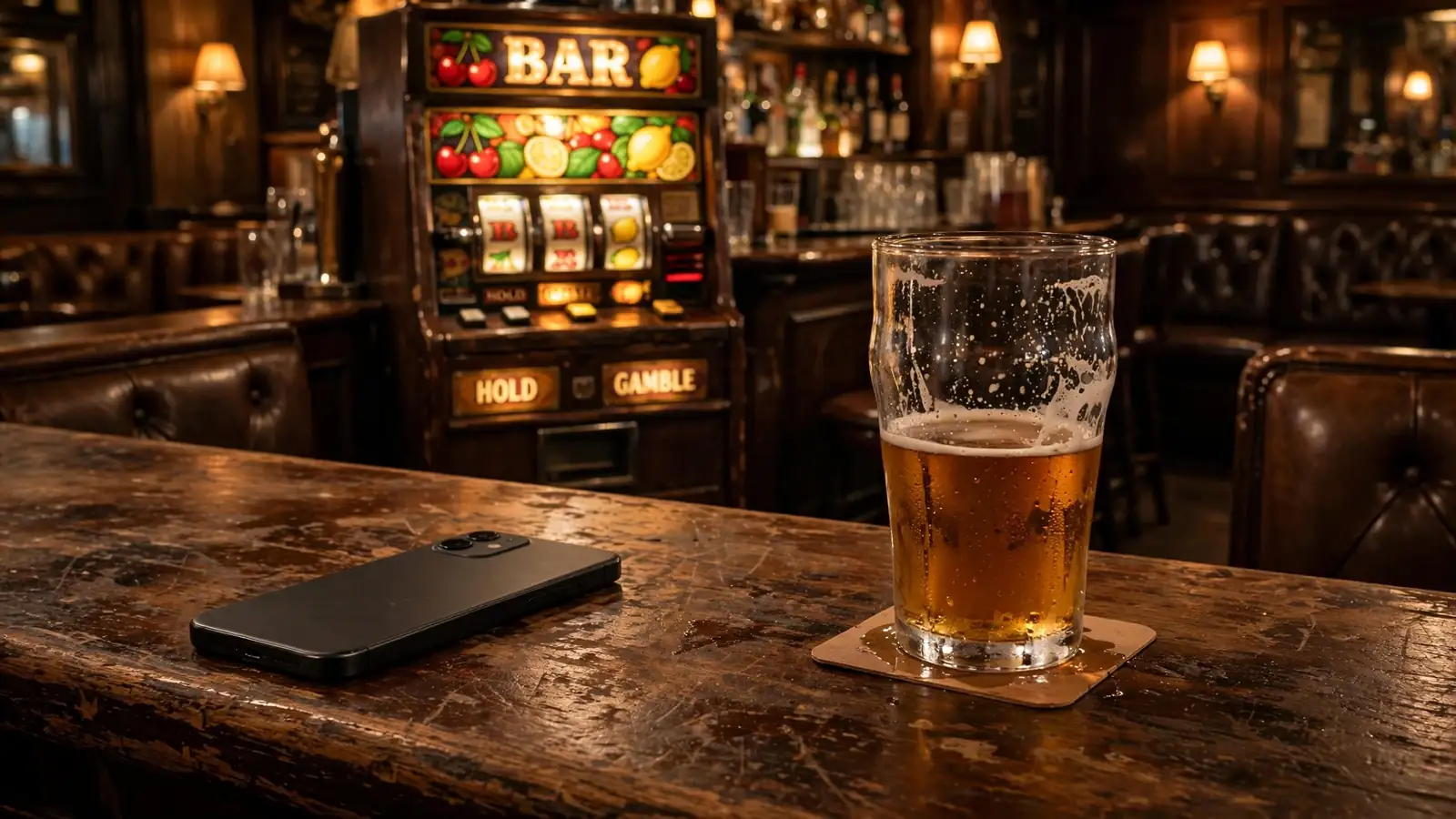
Table of Contents
- From Pub Fruit Machines to the Digital Reel
- The Casino Licence Behind the Game
- Real-Money Play, With the Limits in View
- Rainbow Riches and the Fruit-Slot Family
- Fruit-Slot Games in the Casino Mix
- Online Features Around the Spin
- The Spare-Reel Logic of Classic Machines
- Demo Play and What It Can Establish
- Bonus Terms, Not Just Free Spins
- Reading RTP Without Treating It as a Promise
From Pub Fruit Machines to the Digital Reel
The pub fruity was once part of the furniture: a bright cabinet set among the quieter business of a pub, arcade or betting shop. Its appeal depended on being immediately legible. Fruit symbols, a short row of reels and a visible result made the machine easy to recognise, even to someone who knew little about how it worked. Online fruit slots inherit that visual language, but the cabinet has given way to a screen and the mechanism behind the display has changed.
The shift was not simply a matter of putting a physical machine on a website. Digital games can reproduce the familiar fruit-and-reel appearance while using software to determine each result. A random number generator, or RNG, produces outcomes independently. The reels are the way that result is shown; their movement does not mean that a particular symbol is physically travelling towards a winning position. The display borrows the gestures of a machine, while the outcome comes from a digital process.
That distinction helps explain why online fruit machines can look traditional without behaving like mechanical cabinets. On an old-style display, the symbols appear to settle into a line. On screen, the animation presents the result in a familiar form, but each spin is a separate outcome. The machine’s visual grammar survives; the moving parts do not.
For UK fruit slots, the most recognisable modern arrangement is a grid of five reels, each showing three symbols. The grid offers more room than the compact layouts associated with older fruit machines, while keeping the central image simple: symbols land in rows, and the game indicates whether they form a winning combination. Many such games use fixed paylines. These are routes across the grid along which symbol combinations are assessed, rather than lines chosen by a player before each spin.
Amatic Games at UK Online Casinos: How They Work
The number of fixed paylines can vary considerably between titles, from 10 to 50. That range matters to the shape of a game, but it does not make the underlying process less random. A line is a way of defining which arrangements count; it is not a prediction of what the reels will show next. The distinction is easy to lose amid the lights and sound. The rules describe how a result is recognised, not how to summon one.
Some online fruit slots use a different structure: 243 ways to win. Instead of relying on a set of drawn paylines, this format counts matching symbols across adjacent reels, starting from the left. It changes the routes by which a combination can qualify, and makes the grid’s possible patterns less dependent on a small set of visible lines. The phrase sounds like a promise of abundance. It is, more plainly, a description of the game’s evaluation system.
Megaways takes the changing-grid idea further. Its reels can show different numbers of symbols from one spin to the next, so the number of possible winning ways is not fixed in the same fashion as a standard grid. The system can produce as many as 117,649 ways to win. That large figure describes the structure available on a spin, not a likelihood of winning or a measure of what a win will pay. A count of routes is not a forecast.
These formats show how the fruit-machine category has stretched without abandoning its old visual cues. The fruit symbols and reels offer continuity; the grid, paylines and changing reel heights supply newer ways to organise outcomes. A game can therefore feel like a descendant of the pub machine while presenting a much denser set of possible combinations. The resemblance is cultural as much as mechanical.
Slots at UK Online Casinos: Providers and Games
That continuity is part of the category’s staying power. A screen full of symbols still recalls the public spaces where fruit machines became familiar, even when the software underneath is unlike the cabinet’s mechanism. The familiar image does useful work: it tells a player what kind of game this is before its rules are read. The rules, however, belong to the particular digital title, not to a single timeless idea of a fruit machine.
“Online fruit slots” is consequently a broad label rather than one fixed design. It can mean a straightforward five-reel grid, a game counting 243 ways to win, or a dynamic Megaways layout. All share the inheritance of the physical fruit machine and the use of independent RNG outcomes, but the screen can arrange symbols and count combinations in different ways. The old cabinet has become a family of formats.
Top online casinos in the UK
- SlotoSportBonus: 500% up to £ 10 200+ 777 FS · Payout speed: 1-3 business days
- x3betBonus: Welcome Pack 100% Up to £1.000 + 200 Free Spins · Payout speed: 1-3 business days
- DieselwinBonus: Welcome Pack 250% up to £4000 + 200 FS · Payout speed: 1-3 business days
- WinBeastBonus: €5000 + 500 FS + €650 Freebet · Payout speed: 1-3 business days
- JetsetspinsBonus: 200% Bonus + 100 Free Spins + Free Royal Wheel · Payout speed: 1-3 business days
- SpinFormulaBonus: 550% Up To £15,000 + 550 FS · Payout speed: 1-3 business days
- NightLuckBonus: Welcome Pack + 805% Up To 6400€ + 280 FS · Payout speed: 1-3 business days
- ChanzeBonus: Slots Welcome Bonus #1 200% up to €500 · Payout speed: 1-3 business days
- ZombillionBonus: Welcome Pack 250% up to £4000 + 200 FS · Payout speed: 1-3 business days
The Casino Licence Behind the Game
A fruit machine on a screen can look reassuringly familiar: bright symbols, a recognisable cabinet style, perhaps the same cheerful confidence once found beside a pub’s quieter conversations. But the appearance belongs to the game. The legal responsibility belongs to the operator providing it. For online casinos serving people in the UK, that distinction matters more than polished design, a familiar name or a prominent promise of choice.
The UK Gambling Commission requires an online casino targeting UK players to hold a valid Commission licence. The rule applies whether the business is based in Britain or elsewhere: selling into the British market brings the operator within the UK licensing system. A site’s claim to be “international”, or its use of British imagery, does not replace that requirement. Nor does a supplier’s reputation establish that the casino itself is licensed.
New Online Casino Sites UK: Amatic Games Explained
This is why the phrase “UK casino” can be less informative than it sounds. A site may accept customers from Britain without being authorised to serve them under UK rules. Offshore casinos operate outside the Commission’s regulatory system. Their pages can resemble those of licensed businesses, and their fruit slots may be presented with the same polished interface. Presentation is easy to copy. Regulatory status is not a design choice.
What a licence attaches to
A licence concerns the operator and its permission to offer gambling to the market, not a general seal of approval for everything visible on a website. It does not mean that every game title, version or configuration is available at every licensed casino. A supplier’s licence is not proof that a particular build is live at a particular operator; the game’s own help information is the place to check its details.
That boundary is useful because online casinos often gather many different products under one roof. The fruit-machine section may sit beside table games, bingo or other forms of gambling, but a recognisable game catalogue cannot answer the more basic question of who is legally offering it. Licensing is about the business’s standing in the market. The reels are another matter.
The Commission licence also does not turn gambling into a dependable source of income, or remove the uncertainty built into a game. It says that the operator is within the British regulatory framework; it does not promise a particular outcome or make a casino’s visual style evidence of quality. A glossy lobby is still a lobby.
The protections attached to the market
The practical importance of licensing becomes clearest when something goes wrong. A player using a UK-licensed casino is dealing with an operator required to hold permission for the British market. That gives the relationship a regulatory framework which an offshore site does not provide. UK players at offshore casinos lose access to UK Gambling Commission protections, GAMSTOP and IBAS dispute resolution.
Unlicensed Casinos
UK players at offshore casinos lose access to UK Gambling Commission protections, GAMSTOP and IBAS dispute resolution. Unlicensed sites may manipulate games or withhold payouts without legal recourse.
Those differences are not decorative. A dispute about an account or an unpaid withdrawal can become difficult to resolve when the operator sits outside the system governing British gambling. Unlicensed offshore sites may manipulate games or withhold payouts, while a player may have no effective legal recourse. The absence of UK oversight is not repaired by a customer-service chat window, a large bonus banner or a claim that the site serves players worldwide.
GAMSTOP’s role is specifically self-exclusion across participating operators; IBAS provides dispute resolution. Neither is a substitute for choosing a licensed casino in the first place, and neither should be assumed to cover an offshore site. A familiar fruit-machine title can travel across borders more easily than the protections around it. The name on the screen may be the same; the rules around the account are not.
This is also why a search for the best place to play fruit slots cannot be settled by counting titles or judging the lobby’s appearance. A substantial game library says little about whether the operator is legally entitled to serve the UK. The threshold question is operator status. Only after that does it make sense to consider which games are actually available and what their own information says.
There is a social history in this small distinction. The old pub fruity was part of a local setting, visible to the people around it and governed by rules attached to a physical venue. The online version arrives through a business that may be nowhere near the player. Licensing is one way the state makes that distant relationship answerable to local rules. It is less theatrical than a spinning reel. It matters more.
Stakelogic Casinos in the UK: Amatic Supplier Facts
A legal online casino serving UK players must hold a current UK Gambling Commission operating licence. That is the essential dividing line between a site merely accessible from Britain and one authorised to serve the British market. Familiar graphics cannot supply the difference, and a foreign address does not erase the obligation.
The interface can imitate almost anything. Oversight cannot.
Real-Money Play, With the Limits in View
The difference between a fruit machine in a pub and a fruit slot played for money online is not merely the screen. Online play begins with an account: a record of who is playing, which can be checked and limited. In Great Britain, real-money play is for adults aged 18 or over, and registration requires verified identity. The procedure may feel administrative, but it places the game within a system that is expected to know whose account is being used.
That matters because safeguards attach to the account, not to the bright fruit or the familiar sound of a win. A fruit-machine theme can borrow the atmosphere of a pub fruity; it cannot make online gambling anonymous. Identity checks establish access, while account controls set boundaries around stakes and deposits. Neither turns a random game into a source of income. Gambling remains entertainment, and a budget is safest when it is treated as money already spent.
Do
- Use verified identity for registration
- Set boundaries around stakes and deposits
- Treat gambling budget as money already spent
Don’t
- Attempt to gamble anonymously online
- Use gambling as a source of income
- Ignore the random nature of the game
The stake is a boundary, not a suggestion
Regulatory guidance sets maximum online slot stakes in Great Britain according to age. Players aged 25 and over are limited to £5 per spin, while those aged 18 to 24 are limited to £2. The lower cap for younger adults reflects a particular judgement about exposure to harm: the same spin does not carry the same permitted stake across every adult account.
The limit is not meant to depend on a player remembering the rule or choosing to obey it. Operators must apply the cap at account level and must not let a player exceed it. That makes the control part of the machinery of online play: the stake available through the account is constrained before a spin is made. A game may display a range of stake buttons, but the legal ceiling still governs what can be placed.
This can make online fruit slots seem less like the old machine, where the visible controls were part of the attraction. Yet a restriction is not a design flourish. It is a line set around the transaction. A larger stake is not made permissible by a jackpot feature, a fast interface or the belief that one more spin will recover earlier losses. The account is supposed to stop the excess, not merely record it afterwards.
Amatic Online Casinos in the UK: Slot Formats
Limits that can be set before play
Stake caps address the size of an individual spin. Other controls concern the wider pattern of play. Many UK-licensed operators provide deposit limits, session-time reminders and reality checks. These tools can make spending or time more visible while play is under way, at a point when attention is often narrowed to the next result.
Their usefulness depends on how they are used. A deposit limit can set a boundary around money added to an account; a reminder can interrupt the smooth passage from one spin to another. Neither changes the outcome of a game, and neither should be mistaken for a guarantee against harm. They are practical controls, not a promise that a session will remain harmless simply because a setting exists.
A loss limit set before play gives the session a stopping point that is not decided in the heat of a losing run. Chasing a jackpot with money that cannot be afforded is the opposite of a boundary: it lets the game’s uncertainty dictate the next decision. Winnings, if they occur, are best regarded as an extra, not as income that can be relied upon.
When the right boundary is exclusion
For someone who needs a break from gambling, reducing a stake may not be enough. GAMSTOP is a self-exclusion service that blocks registered players from gambling with every operator on its scheme for a chosen period: six months, one year or five years. The service’s stated exclusion periods are a more substantial boundary than a reminder or a deposit setting, because the purpose is to prevent access across participating operators.
GAMSTOP
GAMSTOP is a self-exclusion service that blocks registered players from gambling with every operator on its scheme for a period of six months, one year or five years.
Self-exclusion is not a feature of a particular fruit slot. It applies beyond the game and beyond the moment of decision. That distinction matters: a player may move from one title to another, or from one participating operator to another, while the underlying difficulty remains. GAMSTOP is designed to interrupt that movement across its scheme.
The controls around real-money fruit slots therefore operate at different scales. Identity verification establishes who can open an account; stake caps limit what can be risked on a spin; account tools can help contain deposits and time; self-exclusion creates a wider barrier. None changes the chance built into a game. Their purpose is more modest and more important: to keep the decision to play from expanding without limit.
Rainbow Riches and the Fruit-Slot Family
Rainbow Riches began not as a familiar image on a phone screen but as a cabinet game. Barcrest introduced it in 2006, placing it in pubs, arcades and betting shops across the UK. Those settings mattered. A fruit machine was part of a room’s social furniture: visible, audible, and encountered alongside a pint, a queue or the ordinary pause between errands. The game belonged to a public culture of brief visits and passing attention.
Barcrest Casinos UK: Amatic Supplier Explained
Its journey online came around 2009. The change was more than a transfer from cabinet to browser. A machine once encountered in a particular place became a title that could sit in a much wider catalogue, detached from the pub’s lights and noise. The name travelled; the surroundings changed. That is one reason Rainbow Riches offers a useful landmark in the history of fruit-machine-style games: its story links the physical cabinet era with the later world of online releases.
There is an important difference between the versions beyond their setting. Physical Rainbow Riches machines are generally configured to return less than the online version’s 95% RTP. That comparison is about the stated configuration, not a prediction of what any player will receive in a particular session. It also resists a comforting assumption that a familiar title must work identically wherever it appears. A name can remain recognisable while the build and its published details differ.
The broader Rainbow Riches family includes Rainbow Riches Pick’n’Mix, Rainbow Riches Megaways and Rainbow Riches Freespins. Their names mark the ways a single title can branch into distinct releases, rather than simply reappear unchanged on a different screen. The family also sits beside other named fruit-themed titles, including Piles of Cash and Rainbow Reveal. Together, such names show how online catalogues preserve the recognisable language of fruit machines while allowing individual games to develop separate identities.
That continuity is not the same as a single, fixed tradition. The old cabinet could be remembered through its title and visual character; digital versions can carry that identity into formats and presentations that were not part of the original pub encounter. The word “family” is apt, provided it is not taken to mean that every relative shares the same rules or configuration. Each release is its own game, and its details belong to that particular version.
Rainbow Riches
The original title that linked physical cabinet era with online releases, known for its 95% RTP online.
Rainbow Riches Pick’n’Mix
A branched release within the Rainbow Riches family, offering a distinct version of the theme.
Rainbow Riches Megaways
A dynamic layout version that applies the Megaways system to the fruit-slot family.
Rainbow Riches Freespins
A specific release focused on the free spins mechanic within the broader family of titles.
This distinction matters when people look for traditional fruit machine games or their online descendants. Familiarity often begins with a title, but a title alone cannot establish how a specific release behaves or what its published return is. Rainbow Riches is a case study in that small but consequential gap between memory and product. A remembered cabinet may summon one experience; an online release may share its name while offering a different configuration.
The move online also changed the scale at which a fruit-machine identity could circulate. A pub cabinet had a local address, even if its name was widely known. An online title could appear among many other games, its past compressed into a logo and a few familiar words. The cabinet had made the game part of a place. The screen made it portable.
That portability helps explain the enduring appeal of fruit-themed slot games without turning the category into a contest for a single “best” title. Rainbow Riches is notable here not because its descendants can be ranked from their names, but because its history makes visible a transition in British leisure: from a machine installed in shared spaces to a digital game encountered through a catalogue. The transition did not erase the old machine. It gave its name another life, under different conditions.
A title can travel further than its cabinet.
Fruit-Slot Games in the Casino Mix
In a UK online casino, fruit-machine-style games sit among other forms of casino entertainment, but their familiar symbols can make them feel more hands-on than their underlying mechanics are. A spin may be framed by a choice, a pause or an extra step. That presentation does not mean the player is steering the result.
The reels’ outcomes are determined by a random number generator, with each outcome independent of the one before it. A near miss does not make a win more likely on the next spin, and a run of wins does not create a debt that the game must repay. The fruit imagery may carry the memory of a pub machine, but the digital game is not keeping score in a human sense.
Pragmatic Play Online Casinos in the UK: What to Check
Some titles add holds or nudges, familiar ideas that give a spin a small decision point. A hold keeps selected reels in place while others spin again; a nudge shifts a reel by one position in an attempt to bring a different symbol into line. These actions can make the game feel less like a single button press and more like a brief exchange with the machine.
But the exchange has limits. Holds and nudges do not alter the random process that determines outcomes. They add variety and a sense of participation, not control over the underlying odds. The distinction matters: choosing which reel to hold may be a real choice within the game’s rules, while the final result remains governed by its random mechanics.
This is one reason fruit machine casino games can look unlike other casino games without becoming a different kind of bargain. Their symbols, sounds and small interventions shape the experience; they do not turn a random outcome into a skill-based one. A player can make a decision the interface permits, but cannot infer from that decision that a prize is due.
The wider casino mix is therefore less a set of promises than a set of presentations. Cards invite one kind of attention; spinning reels invite another. Fruit machines borrow the ritual of the pub fruity, then place it inside a digital game whose outcomes remain beyond the player’s command. The choice is part of the show. The chance is still the engine.
Online Features Around the Spin
The online fruit machine has acquired a small theatre around its reels. A spin may lead to free spins, or to a pick-style mini-game in which symbols or prizes are revealed through an extra choice. These additions change the pace and presentation of a game, but they do not turn its outcome into a negotiation between player and machine.
A specialist review describes features such as free spins and pick-style rounds among the options found in online fruit-machine games. Their presence is title-specific, not a promise attached to the whole category. One game may keep its play close to a familiar fruit-machine rhythm; another may interrupt the reels with a bonus screen, sound effects and a new set of prompts. The decoration can be elaborate. The underlying purpose remains simple: to give the spin more stages to pass through.
Penny Slot Machines in the UK: Costs and Play
Autoplay and quick spin alter the tempo rather than the rules. Autoplay can repeat spins without a fresh button press each time, while quick spin shortens the visible pause between them. Neither makes a result more favourable. They can, however, make a session feel less deliberate, because the small gap in which a person might reconsider is reduced. Speed is a feature of presentation, not evidence of control.
The screen itself travels too. Mobile compatibility allows some fruit games to be played on a phone or tablet, with controls and reels arranged for a smaller display. That portability brings the game into places once separated from the bright, fixed cabinet: a journey, a waiting room, a quiet corner at home. The machine no longer needs a room of its own.
This is part of the digital transformation, but not necessarily progress in any moral sense. Convenience and restraint are different qualities. A bonus animation can make a losing spin feel like an event; a quick button can make the next one arrive before the last has settled in memory. Features may be entertaining, yet their presence says little about whether a particular game suits its player. The sensible distinction is between what a game shows and what it changes: extra screens, faster motion and portability reshape the experience, while the player’s choices still sit outside the spectacle. The lights have moved. The old temptation has travelled with them.
The Spare-Reel Logic of Classic Machines
A classic fruit machine keeps its grammar short: three reels, one payline, and few features competing for attention. Symbols pass through a narrow window; the question is whether they settle into a line the paytable recognises. Compared with more elaborate digital games, the arrangement leaves little room for spectacle. Its interest lies in the small interruption.
That interruption may be a hold. Selected reels stay where they are while the others spin again, preserving part of the visible arrangement for the next round. A nudge works differently: after a spin, a reel shifts down by one position, bringing another symbol towards the payline. Neither action adds a second game beneath the first. Each offers a limited point of choice within the spare layout.
Amatic Games in UK Online Casinos: Who Runs Them
The names suggest more power than the mechanics provide. Holding a reel does not make its symbol more likely to complete a winning line; nudging changes what appears in the payline, not the random process that determines the outcome. The decision concerns how to use an available feature, not how to command the result. A narrow choice, then. Still a choice.
The details are not uniform across classic fruit slot machines. A specialist review may describe a particular title’s holds or nudges, but that account should not be mistaken for a rule applying to every game. The number available, and the conditions under which they appear, depend on the title. One game may offer more than one; another may make the feature available only in particular circumstances. The game’s own help or paytable is the place to establish what that version actually does.
This restraint is part of the format’s character. On a three-reel screen, a held symbol remains conspicuous, and a one-position nudge has an immediately legible consequence: a different symbol may enter the line. The interface makes the moment easy to read, without turning it into a promise. Old machinery, now rendered in pixels; the suspense survives, but the lever has become a rule in the game.
Demo Play and What It Can Establish
A fruit slot demo, where a casino makes one available, offers a way to inspect a particular game without treating a short run of spins as evidence of what real-money play would produce. It can show how the reels, symbols and on-screen features are presented, and allow the game’s controls to be explored. It cannot establish that a run of wins or losses predicts what comes next: each outcome is generated independently.
The more durable information is in the game’s help screen and paytable. These set out the rules, symbols and published return figure for the version on display. That detail matters because the same title may be supplied in versions with different published RTPs. A specialist game review can describe a version, but the paytable at the specific casino is the relevant place to check what that casino has made available.
A demo may not be offered for every title or at every casino, and its presence should not be assumed. Where it is available, it can clarify the game’s presentation and help locate its published rules. It does not prove that a different version has identical settings, nor does a brief sequence reveal the game’s long-run return. The demonstration is a window, not a forecast.
Demo Limitations
Attention: A fruit slot demo cannot establish that a run of wins or losses predicts future real-money results, as each outcome is generated independently.
That distinction is easy to lose amid bright symbols and animated wins. A displayed result belongs to that spin; the paytable describes the game’s stated terms. Neither turns chance into a schedule. A demo is useful for reading the object in front of the player, not for discovering a reliable route through it.
Bonus Terms, Not Just Free Spins
A fruit-slot promotion is a set of conditions, not simply a bundle of spins. A wagering requirement says how much must be staked before bonus-derived funds can be withdrawn; game contribution rules determine which bets count, and at what rate. A large casino library does not mean every fruit machine qualifies. The live terms matter more than the banner.
For bonus funds, the UK Gambling Commission’s Social Responsibility Code 5.1.1 sets a ceiling: the wagering requirement cannot exceed ten times the bonus amount. That limit does not make every offer equally useful. A promotion may still restrict eligible games or apply different contribution weights, so the amount of qualifying play can depend on the title selected. Free spins also have their own conditions, including which game they apply to and what happens to any winnings.
A specialist review of the regulatory changes dates the wagering and mixed-product incentive rules to 19 January 2026. The mixed-product rule means a single incentive cannot combine gambling products such as casino games and betting. For a fruit-slot offer, the distinction is practical: terms should identify the eligible casino play rather than quietly tying the reward to another product.
Before opting in, the useful details are the wagering multiple, eligible games, contribution rates, expiry conditions and any limits on winnings. An offer that appears generous can require substantial qualifying play, while a game that looks like a fruit machine may not count toward the promotion at all. No promotional label replaces the terms.
A no-deposit offer or free-spin bundle should be treated as current only when it appears in the operator’s live official promotion terms. Promotional copy is the shop window; the conditions are the transaction.
Reading RTP Without Treating It as a Promise
Return to player, or RTP, is a theoretical measure of how much a game returns across a very large volume of play. For UK fruit-machine-style slots, published figures commonly sit between 94% and 97%, although individual titles can fall outside that band. The number describes an aggregate, not a forecast for a particular spin or evening.
That distinction matters when a game is advertised as a high-payout fruit slot. A higher RTP indicates a larger theoretical return over time, compared with a lower figure, but it cannot tell anyone what will happen in a short session. Random outcomes can cluster: a run of wins, or a dry spell, is not evidence that the stated RTP has changed. The arithmetic belongs to the long run. The player experiences the next spin.
Nor does a title name alone settle the matter. A specialist review has noted that the published RTP can differ between versions of the same game. The paytable and help information for the specific version available at a casino are therefore more useful than a figure attached to the title elsewhere. A supplier’s release may appear in more than one configuration; a familiar name is not proof that every build shares one return rate.
RTP also says nothing about how entertaining a game will feel, how often it pays, or the size of any individual win. It is a comparison tool, not a promise of income or a guide to what a session will deliver. Fruit machines remain gambling, with outcomes determined independently from spin to spin. A budget set in advance keeps that distinction visible; chasing a return turns a statistical description into something it was never meant to be.
Can I play fruit slots for real money in the UK?
Yes, if you are 18 or over and use an online casino licensed by the UK Gambling Commission. Identity verification is required, and the maximum stake per spin is £5 for players aged 25 and over or £2 for those aged 18 to 24.
How do holds and nudges work in online fruit machine slots?
A hold keeps selected reels in place while the others spin again; a nudge shifts a reel by one position after a spin. Their availability and conditions vary by game, and neither changes the random process determining outcomes.
What is the RTP of Rainbow Riches?
The online version of Rainbow Riches has an RTP of 95%. RTP can differ between versions, so check the paytable for the specific game at the casino.
How can players win at fruit machine games?
Players win when symbols form a qualifying combination on the game’s paylines or winning ways. Each outcome is determined independently by an RNG, so no method can guarantee a win.
Written by the editors at mr Play.