Live Roulette UK with English-Speaking Dealers
 Available in GB
A practical look at the live-table experience and the rules, costs and game options that shape online roulette in the UK.
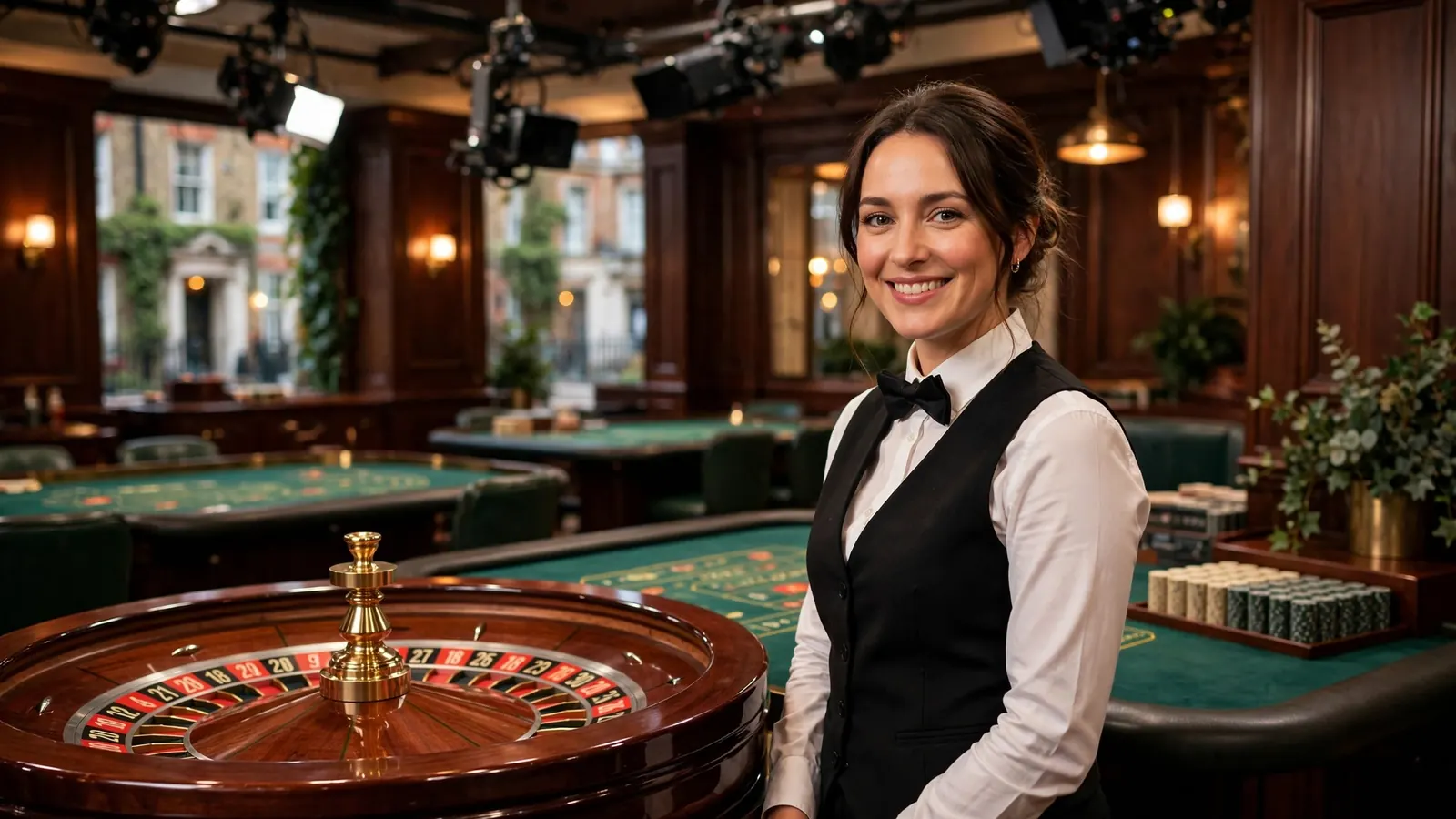
Table of Contents
- The Live Casino Is a Room, Not Just a Roulette Table
- Roulette Online, Under British Rules
- A Casino Site Is Only as Useful as Its Licence
- Roulette at the Live Table: The Game and Its Neighbours
- What Makes a Roulette Casino Worth Considering
- Taking a Seat: Deposits, Limits and the Cost of Play
- Roulette Bonuses and the Conditions Around Them
- Free Roulette: What the Available Facts Do—and Don’t—Establish
- Winning at Roulette Is Not a Reliable Plan
- Lightning Roulette and the Live-Game Variants
The Live Casino Is a Room, Not Just a Roulette Table
A roulette table on a screen can look like a solitary pursuit: a wheel, a wager, a result, then the next decision. The live-casino format changes the setting. A human dealer appears at the table, and the game unfolds in a shared space, even when its participants are watching from separate homes. That presence gives online roulette a social frame. The dealer is not merely part of the picture; they make the table feel like a place where something is happening among people.
The room is digital, but its customs come from the casino floor. There is a host, a visible table and a sequence of actions that other participants can follow. The dealer’s work supplies continuity: attention moves around the table, the game is presented, and the result becomes a public event rather than a private animation. A roulette casino in this form borrows some of the theatre of an evening out, without recreating the whole evening. The clothes, the journey and the small negotiations of a crowded room are absent. The ritual remains.
That distinction matters because roulette does not arrive alone. Live casinos bring together different table games, giving the format the character of a room with several tables rather than a single machine devoted to one pastime. Card games sit beside roulette; each has its own pace, conventions and relationship between dealer and participants. The variety changes the social atmosphere. A person may come for roulette, but the wider live-casino setting suggests a broader idea of casino play: not one isolated game, but a collection of tables with human hosts.
Mr Play Casino Games: Slots & Table Providers in the UK
Grosvenor offers a useful point in that history. In 2013, it unveiled live casino games that included Blackjack, Texas Hold’em and Roulette, alongside other card and casino games. The significance is not that one launch defines the whole format, but that roulette was presented as part of a mixed table-game offer from the outset. It belonged in company. That is a small but telling difference from treating a roulette game as a self-contained digital product.
The dealer is central to this sense of company. A live host gives the table a human rhythm, one that software alone cannot quite imitate. There is a face attached to the proceedings and a person carrying out the familiar role of dealer. Even when the interaction is limited, the presence changes how the game is read. A wheel or card table becomes part of a performance, with the dealer serving as both participant in the ritual and guide through it.
This is not the same as being in a physical casino. The room does not contain the incidental life of a public venue: people arriving, leaving, speaking across tables or deciding where to sit. Online, the table is framed by a screen and the social connection is narrower. But narrow is not the same as absent. The visual presence of a dealer and the awareness of other players can give a session a shared quality. The table is watched together, though not necessarily experienced together in the fuller sense of a night out.
The appeal of live roulette in the UK, then, is partly about the game and partly about its setting. People have long gathered around casino tables not only to follow outcomes but to inhabit a public ritual: taking turns, observing, waiting, reacting. Online casinos with roulette borrow that arrangement and compress it. The dealer remains visible; the room becomes an interface. There is a human being in the frame, but the ordinary social world around them has been edited away.
Mines casino game UK: wagers, demos and real-money play
That editing has its own character. A live table can feel more personal than a purely digital game, while still being carefully bounded. The dealer’s attention belongs to the table and its procedure. The participant sees a host, not a private companion. The format offers sociability at a distance, with the formality of casino play intact and the unpredictable bustle of a physical venue reduced.
For roulette casinos in the UK, this wider environment is part of the experience before any question of individual game preference arises. The table sits within a live-casino offer shaped by dealers and neighbouring games. Blackjack and Texas Hold’em, for instance, place card play alongside the wheel in Grosvenor’s early live offering. A room takes shape through that mixture: different games, different rhythms, one shared convention of the dealer-led table.
Not quite a night out. Still, a room.
Top online casinos in the UK
- SlotoSportBonus: 500% up to £ 10 200+ 777 FS · Payout speed: 1-3 business days
- x3betBonus: Welcome Pack 100% Up to £1.000 + 200 Free Spins · Payout speed: 1-3 business days
- DieselwinBonus: Welcome Pack 250% up to £4000 + 200 FS · Payout speed: 1-3 business days
- WinBeastBonus: €5000 + 500 FS + €650 Freebet · Payout speed: 1-3 business days
- JetsetspinsBonus: 200% Bonus + 100 Free Spins + Free Royal Wheel · Payout speed: 1-3 business days
- SpinFormulaBonus: 550% Up To £15,000 + 550 FS · Payout speed: 1-3 business days
- NightLuckBonus: Welcome Pack + 805% Up To 6400€ + 280 FS · Payout speed: 1-3 business days
- ChanzeBonus: Slots Welcome Bonus #1 200% up to €500 · Payout speed: 1-3 business days
- ZombillionBonus: Welcome Pack 250% up to £4000 + 200 FS · Payout speed: 1-3 business days
Roulette Online, Under British Rules
An online roulette table may appear to be a small, self-contained world: a wheel, a dealer, a set of wagers and a screen on which the action unfolds. Legally, it belongs to something larger. It is part of remote gambling offered to people in Great Britain, and the operator behind it must answer to the regulator responsible for that market.
That regulator is the UK Gambling Commission. It oversees commercial gambling in Great Britain, including online casinos, and is the sole regulator for commercial gambling there. The distinction matters because a casino’s website can make its own rules visible and polished, while the authority to offer real-money play comes from a public regulatory framework outside the site itself.
Live Dream Catcher Casino UK: What to Check
For a roulette casino online, the central question is therefore not where the wheel is filmed, where a studio is based or where the operator keeps its main equipment. The Commission’s reach over remote gambling offered to consumers in Great Britain does not depend on the location of the equipment used to provide it. A business cannot set the regulatory question aside simply by placing its servers or a live table elsewhere.
That is one of the peculiarities of online gambling: the service crosses borders more easily than the rules governing it. A screen can make the table feel placeless, but the operator’s obligations are tied to the market it serves. If a business offers remote gambling to consumers in Great Britain, it must hold the relevant Gambling Commission licence. The setting may be distant; the responsibility is not.
The licence belongs to the operator
A roulette game is not itself a licensed business. The company providing the gambling service is the relevant party. The Commission grants operating licences to businesses, while individuals involved in operating gambling in Great Britain may require personal licences. These are different roles within the same system: one concerns the organisation offering the service, the other the people whose work falls within the licensing framework.
This helps clarify what a licence does—and what it does not mean. It is not simply a badge attached to a particular roulette wheel or a sign that every feature on a casino site has been separately endorsed. It establishes that the business has the appropriate authority to provide the relevant gambling service in the regulated market. The licence sits behind the experience, as part of the conditions under which that experience may be offered.
The distinction between a game and its provider can be easy to miss. A site may present roulette alongside other casino products, but the regulatory question attaches to the business making those products available. In practical terms, the operator’s legal status matters more than the visual identity of an individual table.
The Gambling Commission grants operating licences to businesses, while individuals involved in operating gambling in Great Britain may require personal licences.
A British market, not a remote loophole
The Commission’s authority over remote gambling reflects a choice about responsibility. Distance does not dissolve the relationship between an operator and the people to whom it offers gambling. A company serving consumers in Great Britain remains within the regulatory framework even if the equipment supporting the service is located beyond the country.
This is why the phrase “online casino” can be misleading when treated as a description of geography. The casino may have no traditional building for the player to enter, and the technical operation may be distributed across locations. Yet the service still has a defined market, and the business offering it must meet that market’s licensing requirement. Remote does not mean exempt.
The same principle applies to a casino online with roulette as one of its games. The game’s format does not create a separate route around regulation. Whether the wheel is presented through a digital interface or as part of a remote casino service, the operator serving Great Britain must hold the relevant licence. A different screen, studio or equipment location changes the presentation, not the basic obligation.
There is a useful civic idea in that arrangement. Gambling is not treated as a private bargain between a website and a customer alone. The state identifies a regulator, gives it responsibility for commercial gambling and requires businesses entering the market to hold authority to do so. The wheel may turn in a studio far from the customer. The operator still answers to a British regulator.
Online Casino Without ID in the UK: What It Means
What status means in practice
For anyone considering an online casino with roulette, licensing is the threshold issue, not a decorative detail. The relevant question is whether the business behind the service is authorised to provide remote gambling to consumers in Great Britain. A familiar brand name, an attractive site or the presence of live games does not, by itself, establish that status.
The Gambling Commission’s public register is the place to check an operator’s licensing details. The check should concern the actual business providing the service, rather than relying on a game name or a general impression created by the site. Before depositing, the licence number should be verified on the register.
This is a matter of who may lawfully offer the service, rather than a forecast of how a roulette session will go. Regulation cannot turn chance into certainty, and a licence is not a promise of winnings. Its significance is more basic: it identifies the business as one operating within the framework set for commercial gambling in Great Britain.
A regulated online casino is therefore not simply a familiar room translated onto a screen. It is a remote service attached to a licensed operator, overseen by the body responsible for the market it serves. The table is only the visible part. The licence is the less visible condition that makes its presence lawful.
Verify Operator Status
- Identify the business providing the gambling service
- Locate the operator’s licence number
- Verify the licence number on the Gambling Commission’s public register
- Confirm the registered business matches the site’s corporate identity
A Casino Site Is Only as Useful as Its Licence
A roulette site can present a polished lobby, a live table and a familiar game without answering the more important question: which company is providing the gambling service? For a player in Great Britain, that is not a detail to leave in the small print. Remote operators serving customers in Great Britain are required to hold the relevant Gambling Commission licence. The site’s branding and the legal identity behind it may not be the same thing.
The UK Gambling Commission’s public register is the place to check. A name on a homepage, a badge in its footer or a confident claim about regulation is not a substitute for a matching entry there. Before depositing, the operator’s licence number should be verified against the register, along with the business identity and the domain associated with the service. A mismatch is a reason to pause and establish who is actually taking the wager.
This matters when comparing roulette casino sites, including those offering live tables. A list that calls one site “best” or “top” can tell little about whether the provider is authorised to serve the British market. A ranking is a judgement; a register entry is a checkable record. The latter deserves attention before presentation, game selection or promotional language.
A specialist review of the public register reports that, on 26 September 2026, it did not identify a LuckyPays entry under that brand or the stated domain, including luckypays.io. That is a specific finding about the register at that date, not a verdict on roulette sites as a category, nor a substitute for checking the record directly. Register information can change, and names or domains can be easy to confuse. The useful response is to search the exact operator identity and web address, then resolve any discrepancy before using the account.
American Roulette Online in the UK: Licensing and Play
A sound check is more than spotting the word “licensed”. The register should connect the relevant business to the service being offered. If a site presents a trading name, a parent company or a different domain, the relationship should be clear rather than left to inference. Where it is not, the uncertainty is itself material. A roulette table does not become safer because its interface looks expensive.
This is why a useful roulette casino site is not defined by a grand menu or an abundance of live tables. It is one whose operator can be identified and whose status can be checked independently. That standard does not produce a convenient league table, but it does separate evidence from decoration. The distinction is plain.
The same caution applies to claims about the “best live roulette” venue. A live stream may make a table feel immediate and sociable; it cannot establish the operator’s regulatory standing. Nor does a familiar brand name, by itself, show that the particular website is covered. The register is where those details need to meet.
The practical order is unglamorous: identify the remote operator, locate its licence number on the Commission’s public register, and confirm that the record corresponds to the brand and domain in use. If that connection cannot be established, depositing should wait. Roulette remains a game of chance, and any money staked should be money that can be afforded to lose.
Licence Verification
If a connection between the remote operator, its licence number on the public register, and the domain in use cannot be established, depositing should wait.
Roulette at the Live Table: The Game and Its Neighbours
Roulette belongs to the casino’s table-game vocabulary: a wheel at the centre, a layout for wagers around it, and a dealer whose actions give the round its pace. In a live casino, that familiar arrangement is carried onto a screen without turning the game into a solitary sequence of clicks. The table remains a shared point of attention, even when its players are physically elsewhere.
That distinction matters. Roulette is not simply a game that happens to be presented live. Its appeal has long rested partly on watching a public event unfold: the dealer sets the round in motion, the ball travels, and the table waits for its destination. The pause is part of the experience. It gives players time to follow the same small drama, although each person may be attending to a different wager.
The card tables offer a different kind of focus. Blackjack centres on hands and decisions; Texas Hold’em brings cards, opponents and changing possibilities into view. Roulette, by contrast, gathers attention around a single moving object and a marked surface. The games share a room, but not quite a rhythm. One asks for attention to a hand; the other makes the wheel the common subject.
This is one reason the phrase “roulette casino game” can suggest more than a set of rules. In a casino context, roulette sits beside card games as part of a recognisable table culture. The dealer is not merely a voice attached to software. Their presence connects the action to the old, physical grammar of casino play: a table, a round, a moment of suspense, then a reset.
European Roulette at UK Online Casinos: Rules and Safety
Grosvenor’s live-casino launch in 2013 provides a British point of reference. Its opening offer brought together card and casino games, including Blackjack, Texas Hold’em and Roulette. That combination is telling. Roulette was not presented as an isolated novelty, but as one member of a mixed table-game offer, with card games occupying the neighbouring seats in the catalogue.
The relationship between those games is social as much as technical. A player moving from roulette to blackjack does not enter an entirely different institution; the setting retains its dealer-led character, while the object of attention changes. At roulette, the table’s central event is visible to everyone at once. At a card table, the interest gathers around hands and choices. The contrast is modest, but it gives a live casino its texture.
A British roulette casino game can therefore be understood as part of a wider table tradition rather than as a screen version of a wheel alone. The live format preserves the sense of a round being conducted in company, while its neighbours show how varied that company’s attention can be. Some watch the ball. Others follow the cards.
Same room, different tempo.
What Makes a Roulette Casino Worth Considering
“Best” is a tidy word for an untidy choice. A roulette site may look polished, offer a live table and display the familiar green baize, but those details do not establish who is legally responsible for taking wagers. For a casino serving customers in Great Britain, the first test is more prosaic: the remote operator must hold the relevant Gambling Commission licence.
Do
- Verify the licence number on the public register
- Match the registered business against the company in the terms
- Treat the operator’s licence as the primary threshold
Don’t
- Rely on a brand name as proof of regulatory status
- Trust a “best” ranking without checking the register
- Assume a polished layout indicates legal authority
That requirement gives a comparison a firm starting point, rather than a borrowed ranking or a claim about the best odds. The Commission’s public register is where the operator’s licence can be checked. Before depositing, the licence number should be verified there, and the registered business should be matched against the company named in the casino’s terms. A brand name can be different from a corporate name; the important question is whether the licensed entity is clearly connected to the service being offered.
The distinction matters because a casino’s public-facing name is not, by itself, proof of its regulatory status. A register entry should relate to the operator behind the site, not merely resemble its branding. If the details are unclear or do not line up, that uncertainty is a reason to pause, not to fill the gap with assumptions. A licence is not decoration.
Only after that threshold is met does it make sense to consider the roulette experience: whether the table is live or automated, how the rules are presented, and whether the interface makes the available choices intelligible. These are questions of suitability, not evidence that an operator is licensed. A smooth stream, confident presentation or attractive layout can create an impression of authority. None substitutes for a register check.
Live Baccarat Online Casinos in the UK: What to Know
There is also a limit to what “best” can responsibly mean. No single casino can be called the best for every player on the strength of appearance alone, and a label such as “best odds” needs a defined basis before it means anything useful. Roulette is not made more favourable by a site’s self-description. Nor is a strategy made sound merely because a casino promotes a table as a place to use it. The operator’s licence is a checkable condition; claims about superiority require separate evidence.
A restrained assessment therefore begins with identity and standing, then moves to the table itself. The operator should be identifiable, its relevant licence should appear on the public register, and the relationship between that operator and the casino brand should make sense. Anything beyond those checks should be treated as a claim to assess, not a fact conferred by good design.
That is less exciting than a league table. It is also more useful. The licence does not guarantee a particular roulette experience or a favourable result; it establishes who is authorised to provide the service in Great Britain. A necessary threshold, not a trophy.
Taking a Seat: Deposits, Limits and the Cost of Play
Choosing a live roulette table is only part of the decision. Before any real-money play, an account has to be funded, and the terms of that step shape the practical cost of a session. The displayed table limits matter: a stake that feels modest in one setting may not fit another budget. Those limits are not a measure of what a player ought to wager.
Attention: UK-licensed casinos cannot accept credit cards for gambling, including credit-card funding routed through a money service business.
Age checks come before deposits. Gambling operators must verify a customer’s age before allowing funds to be added to an account; online gambling in the UK is for adults aged 18 and over. This is a condition of access, not a box to be hurried through. The account is tied to a person, and the operator’s checks are part of that arrangement.
Payment rules also narrow the route to the table. UK-licensed casinos cannot accept credit cards for gambling, including credit-card funding routed through a money service business. A digital wallet cannot be used for gambling where it permits credit-card funds to pay for it. A payment method appearing on a site is not, by itself, proof that every way of funding it is permitted.
Before the first deposit, remote operators must prompt new customers to set a financial limit and make account-level limit controls accessible. These tools let a player set boundaries before the pace of a session takes over. Casinos must also provide responsible-gambling measures, including self-exclusion. A limit is useful only if it reflects money that can be lost without disturbing ordinary commitments.
There is a distinction between roulette and online slots worth keeping in view. A specialist review reports that Great Britain’s slot stake limits do not apply to roulette or blackjack. That does not make roulette a safer choice, nor does it recommend a higher stake; it simply distinguishes the games under that particular rule. The cost of roulette still depends on the amount wagered and the length of play.
A live table can make the exchange feel social, but the account remains a financial instrument. Deposit controls and payment restrictions are not decorative features around the game. They define how play begins, and where it must stop.
Only money that can be afforded to lose should be used for gambling.
Roulette Bonuses and the Conditions Around Them
A roulette promotion is part of the relationship between a casino operator and an account, not a feature of the wheel itself. A welcome offer, deposit promotion or live-casino bonus may be presented alongside roulette, but its label alone does not establish which games qualify, who can claim it or what conditions apply. Those details belong in the offer’s terms.
Online Casino Tournaments UK: Rules and Limits
The same caution applies to phrases such as “no deposit” or to a promotion attached to a named game such as Lightning Roulette. They describe possible forms of marketing, not a promise that an offer is available, that roulette play counts towards it, or that a particular account is eligible. A casino roulette bonus can sound simple in a headline and prove more conditional in the small print. The small print is the offer.
Before accepting a promotion, the terms deserve a careful read. They should make clear how the offer is activated, which games or activities are included, what conditions apply to any winnings, and whether restrictions affect withdrawal. If those points are unclear, the bonus is difficult to assess on its own merits. A large headline figure cannot answer questions the conditions leave open.
For a UK roulette bonus, the more basic question comes first: which business is actually providing the gambling service? The Gambling Commission requires remote operators serving consumers in Great Britain to hold the relevant licence. The licence should be checked against the operator on the Commission’s public register before depositing or accepting an offer. A promotion does not replace that check, and polished presentation is no evidence of regulatory standing.
This matters because a bonus can make an account feel like a special arrangement, when it remains an operator’s commercial offer governed by its own conditions. The terms should be understandable before play begins, not deciphered after a balance has been used. If the offer’s relationship to roulette is vague, it is safer not to assume that roulette qualifies.
Promotions also do not alter the uncertainty of the game. A bonus is not a route to a predictable return, and accepting one should never be treated as a reason to wager more. Gambling should be limited to money that can be afforded to lose. The wheel remains indifferent.
Free Roulette: What the Available Facts Do—and Don’t—Establish
“Free roulette” can mean different things: a practice game with no real-money stake, a promotional offer, or simply a table that does not require a deposit to begin. Those are not interchangeable arrangements. The phrase alone establishes none of them, and it does not confirm that a particular casino provides a demo game or free-play mode.
There is one narrower distinction worth keeping clear. A specialist gambling review reports that Great Britain’s online slot stake limits do not apply to roulette or blackjack. That is a statement about the scope of those limits, not evidence that roulette can be played without depositing, or that a roulette table is free of financial risk. A rule about one game category cannot be stretched into an offer for another.
The same restraint applies to specific forms of roulette. French Roulette has its own rules, and a named game such as Fireball Roulette may invite questions about how its features work. But a name does not establish the table’s rules, whether it is available in free-play form, or what conditions attach to it. Those details belong to the game and operator information, not to assumptions built from a title.
“Free” can also obscure what is being offered. A no-cost demonstration, where one exists, is different from a real-money game advertised alongside a promotion. The latter may involve account terms; the former may not reproduce the experience or conditions of paid play. Without clear terms for a specific offering, neither should be presumed.
A roulette casino’s edge is another separate matter. It concerns the relationship between the game’s rules and its outcomes, not whether play is free or whether a stake limit applies. A claim about one cannot answer the other. The careful reading is less exciting, but more useful: establish what the particular table offers before treating “free” as a description of its cost.
Real-money roulette remains gambling, whatever its table format. Only gamble what can be afforded to lose.
Key Considerations
- Use only money that can be afforded to lose
- Verify the operator’s Gambling Commission licence before depositing
- Understand that no roulette strategy can guarantee a win
- Distinguish between different types of “free” roulette offers
Winning at Roulette Is Not a Reliable Plan
The wish to find a dependable way to win at roulette is understandable. A table offers an unusually clear drama: a choice is made, the wheel turns, and the result arrives in public. That neat sequence can make uncertainty look as though it might yield to a sufficiently neat system. It does not make a guaranteed method available.
Roulette strategies often give structure to decisions: how to choose a wager, when to stop, or how to respond after a loss. Structure can make play feel more controlled, but it is not proof that a system can secure a win. Nor does a plan become reliable because it is repeated online, described as clever or attached to a confident promise. A run of favourable results is a run, not a dependable forecast.
The same distinction applies to electronic roulette and live tables. The setting changes; the hope of finding a winning formula remains familiar. Yet presentation is not a promise about outcomes. No sensible account of casino play should turn a method into a guarantee, or suggest that persistence can ensure a particular result.
Regulation belongs to a different part of the story. The UK Gambling Commission oversees gambling activity in the United Kingdom, including online casinos. That oversight matters to the operation of the market; it is not a prediction service and does not certify a way to win. A regulated environment and a reliable winning plan are separate things. The first can be established by oversight. The second cannot be conjured from it.
This is one reason claims of a “best” approach deserve restraint. Advice may help organise a session, but organisation is not an advantage by itself. A budget or stopping point can limit exposure; neither changes uncertainty into income. Treating roulette as a source of dependable winnings asks a game to perform the work of a salary. It is an old confusion, dressed in new language.
Only gamble what can be afforded to lose. That warning is not a ritual disclaimer: it is the clearest boundary between entertainment and a financial plan. roulette may produce a win on a given occasion, but no method can make that outcome certain every time. The wheel offers no contract.
Lightning Roulette and the Live-Game Variants
Lightning Roulette belongs to a tradition in which roulette is presented not only as a set of numbered pockets but as a live table, with a dealer and a visible rhythm of play. Grosvenor’s live casino launch in 2013 placed Roulette alongside Blackjack and Texas Hold’em, an early example of the format’s broader table-room setting. The game did not arrive alone.
A named variant such as Lightning Roulette can attract attention, but its title is not a reliable description of its rules, features or odds. Those belong to the particular game presentation and its terms. The sensible distinction is between recognising a game name and knowing what a specific table offers. A casino may display roulette products together, but shared placement does not make their mechanics interchangeable.
The same care applies to labels such as “First Person”. A name by itself establishes neither how a game is shown nor whether it is available in a particular live casino. The table information is the place to establish what is actually being offered, rather than filling gaps with assumptions drawn from the label.
“Lightning Roulette slots” is another category mix-up: roulette is a table game, not a slot. Search results or casino menus may place different products near one another, but proximity is not taxonomy. Nor does a casino’s score or promotional description establish a game’s rules.
Variants can make a familiar table feel newly packaged. The underlying social setting remains recognisable: a dealer, a table, and players following the same round from separate screens. A new name is not a new guarantee. Gamble only what can be afforded to lose.
Are online casino games licensed and regulated?
Yes. Commercial online gambling offered to consumers in Great Britain is regulated by the UK Gambling Commission, and remote operators serving those consumers must hold the relevant licence.
What are the online slot stake limits in Great Britain?
The limit is £5 per game cycle for adults aged 25 and over, and £2 for adults aged 18 to 24. These limits do not apply to roulette or blackjack.
Is LuckyPays licensed by the UK Gambling Commission?
No LuckyPays entry, including for luckypays.io, appears in the Gambling Commission’s public register dated 26 September 2026.
Published by the mr Play team.